
Tadoba Andhari Tiger Reserve
- Home
- Tadoba Andhari Tiger Reserve
Tadoba Andhari Tiger Reserve
Welcome To Tadoba Andhari Tiger Reserve: The Complete Guide to India's Best Tiger Safari
If you’ve searched “Tadoba Andhari Tiger Reserve” more than once this week, you’re probably past the stage of wanting basic facts. You want to know how the booking actually works, what a jeep safari really costs once every fee is added up, and which gate gives you the best shot at a real tiger sighting instead of an empty forest road. That’s exactly what this guide covers, gate by gate and rupee by rupee.
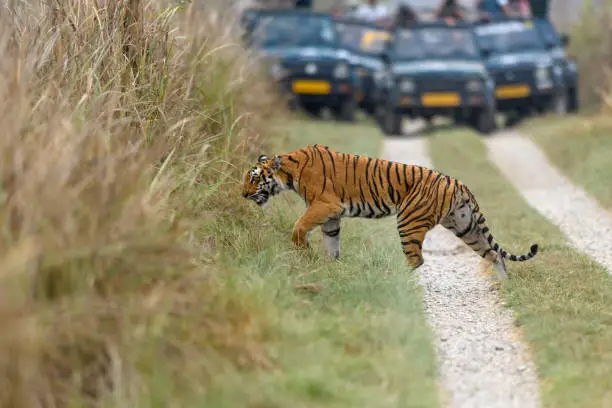
Tadoba Andhari Tiger Reserve
What Is Tadoba Andhari Tiger Reserve?
Tadoba Andhari Tiger Reserve sits in the Chandrapur district of Maharashtra, about 150 km from Nagpur. It’s the state’s oldest and largest national park, made up of roughly 625 sq km of protected core forest sitting inside a much larger buffer landscape that stretches past 1,700 sq km.
The reserve’s name comes from two local sources. “Tadoba” refers to Taru, a deity honored by the area’s tribal communities — local legend holds that he was a village chief who died in a confrontation with a tiger. A small shrine in his memory still stands beside Tadoba Lake. “Andhari” takes its name from the Andhari River, which flows through the southern part of the reserve.
Here’s the number most visitors actually care about: current estimates put the tiger population somewhere between 90 and 115 individuals across the reserve and its surrounding landscape. That density is exactly why Tadoba has become the reserve serious wildlife photographers plan entire trips around, rather than treating it as a backup to Ranthambore or Corbett.
The terrain is a big reason sightings here are so reliable. Tadoba is dry deciduous forest — open teak and bamboo stands with grassland patches, not the dense evergreen cover that swallows movement in some other reserves. Decades of regulated safari traffic have also made the tigers comfortable enough around vehicles that they’ll often walk past a jeep rather than bolt for cover.
A Brief History Worth Knowing
Tadoba wasn’t always a sanctuary — for a long stretch, it was the opposite. The forest was declared a reserved forest in 1879, protected for timber rather than wildlife, and tiger hunting was still legal under permit for decades after.
Restrictions tightened gradually: hunting rules got stricter in 1905 and again in 1931, and by 1935 a small patch around Tadoba Lake was finally set aside as a proper sanctuary. Designated hunting blocks in areas like Moharli and Kolsa still operated under license into the 1940s.
The real shift came in 1955, when Tadoba was formally declared a national park. The Andhari Wildlife Sanctuary was created next door in 1986, and the two were merged in 1993 to form what we now know as Tadoba Andhari Tiger Reserve. That history matters because the same tension that shaped it — people, farmland, and wildlife sharing one landscape — hasn’t disappeared. It’s just being managed differently now, which we’ll come back to later.
How to Book Tadoba Andhari Tiger Reserve Safari
This is where most trips go right or wrong, so it’s worth being precise.
Book only through the official Tadoba Andhari National Park online booking system. Safari permits are issued exclusively by the Maharashtra Forest Department’s own portal — the official site itself carries a scam warning, because fraudulent look-alike booking pages are a genuine, ongoing problem. If anyone offers you a “guaranteed” core-zone slot outside that system, walk away.
Understand Tatkal booking before relying on it. Tatkal slots open a short window — typically around three days before the safari date — to absorb last-minute demand. During peak season (December to February), these can vanish within minutes of the window opening. If your dates are flexible, book standard slots as early as the portal allows instead of gambling on Tatkal.
Decide if you need an agent. For foreign tourists unfamiliar with the portal, large groups, or anyone booking a luxury multi-day package, a registered local operator is worth the markup — they know which zones are realistically bookable on short notice. If you’re comfortable navigating a government site and traveling solo or as a couple, doing it yourself saves money with no real downside.
Know your vehicle options for jeep safari booking in Tadoba Andhari Tiger Reserve. A jeep (gypsy) safari takes a maximum of six people and gives you a closer, more flexible experience for photography. A canter is a larger shared vehicle for up to 18 people — more budget-friendly per head, but only available at select gates like Moharli, and less nimble if you’re chasing a specific angle. A separate cruiser safari option exists for local Chandrapur district residents, booked offline.
Have a backup plan. If core zone slots are gone for your dates — which happens constantly in peak season — a buffer zone safari is a legitimate alternative, not a consolation prize. Some of the calmest, most rewarding sightings happen in buffer zones precisely because everyone else is fighting over Moharli.
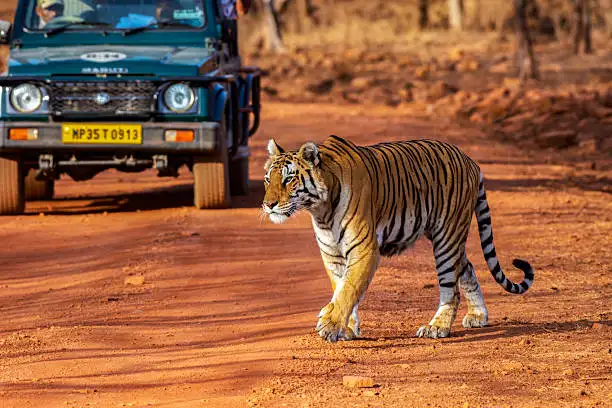
How to Book Tadoba Andhari Tiger Reserve Safari
Tadoba Andhari Tiger Reserve Map: Zones and Gates Explained
Understanding the Tadoba Andhari Tiger Reserve map is really about understanding trade-offs, not memorizing gate names. There are three core zones, each with two gates:
Tadoba Zone — accessible via Kolara Gate and Navegaon Gate
Moharli Zone — accessible via Moharli Gate and Khutwanda Gate
Kolsa Zone — accessible via Zari Gate and Pangdi Gate
Beyond these sit 16 buffer zone gates ringing the periphery, offering a cheaper and often less crowded alternative to the core.
| Zone/Gate | Sighting reputation | Booking difficulty | Best suited for |
|---|---|---|---|
| Maharli | Consistently strong | Hardest — sells out fastest | First-timers, photographers who book early |
| Tadoba/Kolara | Strong, slightly calmer | Moderate | Families, repeat visitors |
| Kolsa | Good, more remote | Easier | Travelers wanting a quieter safari |
| Buffer zones | Variable but underrated | Easiest, often available last-minute | Families, students, budget travelers, backup option |
Here’s a practical example. Say you’re planning a February weekend and, like most first-timers, you only try Moharli. You’re now competing with everyone who read the same advice, on the busiest gate in the reserve during peak season. Booking Kolsa or a buffer gate instead often means a smaller group, less vehicle traffic on the same routes, and sometimes a calmer, less rushed sighting than ten jeeps converging on one tiger.
One honest note: zone reputation is built from guide experience and repeat-visitor patterns, not published official sighting statistics. Treat it as a strong signal, not a guarantee.
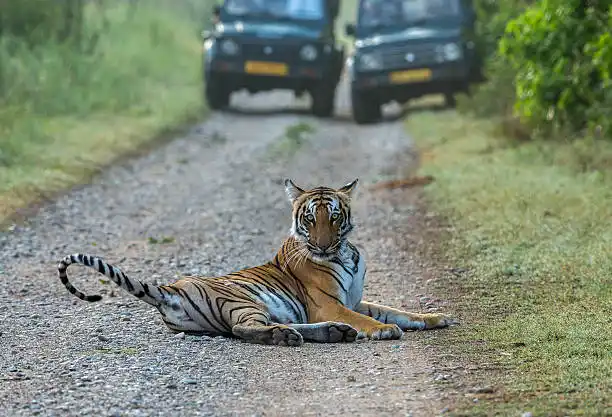
Tadoba Andhari Tiger Reserve Packages
Tadoba Andhari Tiger Reserve Packages and Where to Stay
Accommodation splits fairly cleanly by traveler type, and proximity to your safari gate matters more than it seems — the closer you stay, the less of your pre-dawn morning gets eaten up by a drive before the drive.
Luxury and honeymoon travellers will find jungle lodges near Moharli and Kolara offering in-house naturalists and curated safari planning, priced at a premium that’s genuinely earned by the on-ground expertise.
Families are usually better served by mid-range resorts near Moharli or the buffer zones — comfortable, well-located, and without the early-bird booking scramble of ultra-premium lodges.
Budget travellers and student groups will find MTDC-run resorts and independent budget stays near the buffer gates a solid, affordable option — worth noting that MTDC properties are accommodation providers, not the booking authority for safari permits, which always run through the Forest Department’s own system.
Package bookers: many lodges and operators bundle stay, meals, and safari permits into ready-made Tadoba Andhari Tiger Reserve packages, which simplifies planning considerably for first-time or international visitors who’d rather not coordinate everything separately.
Flora and Fauna in Tadoba Andhari Tiger Reserve
Tigers are the headline, but Tadoba rewards visitors who slow down enough to notice everything else too.
Flora: The reserve is dominated by teak, with bamboo thickets running through it and grassland clearings breaking up the tree cover. This mix of dense forest and open patches is exactly what makes visibility — and sightings — so much better here than in thicker jungle terrain elsewhere in India.
Fauna beyond tigers: Leopards share this landscape with tigers, which is unusual, since leopard populations often get pushed to the margins where tiger density is high. You’ll also find sloth bears, dhole (Indian wild dogs that hunt in coordinated packs), gaur — Indian bison, genuinely massive and easy to spot in open grassland — and nilgai. In 2018, a black panther was photographed in the reserve, a sighting rare enough to make national news, since melanistic leopards usually stick to wetter, denser forest types rather than Tadoba’s dry terrain.
Birding in Tadoba Andhari Tiger Reserve
With close to 195 recorded bird species, this is a serious birding destination in its own right, not an afterthought to the tiger safaris. Tadoba Lake and the Andhari river corridor are the two spots to prioritize. If you’re carrying binoculars, put the grey-headed fish eagle, crested serpent eagle, and Indian pitta on your list. None are guaranteed, but all three are realistic finds if you’re in the right zone during the cooler months.
Practical tip: early winter mornings give you the best combination of animal activity and soft light for photography. In the hotter months, wildlife clusters around water sources, which paradoxically makes sightings more predictable even though the heat itself is punishing.
Online Safari Booking: Step by Step
Visit the official Tadoba Andhari National Park booking portal.
Choose your zone/gate, date, and shift (morning or afternoon).
Select vehicle type — jeep or canter, depending on availability at that gate.
Enter visitor details and upload valid ID (passport for foreign nationals; an accepted Indian ID for domestic travellers).
Pay online and download your confirmed permit.
Carry the original ID and permit copy to the gate — entry is refused without matching originals.
Best Time to Visit Tadoba Andhari Tiger Reserve
There’s no single right answer — it depends on what you want from the trip.
Winter (October–February) is the most comfortable window: pleasant days, good light for photography, and the easiest conditions for families and first-timers. It’s also the busiest and priciest stretch, so book early.
Summer (March–June) gets genuinely brutal, with temperatures climbing past 45°C. But this is the strongest window for serious photographers and sighting-focused travelers, since the heat pushes animals toward waterholes on a predictable schedule.
Monsoon (July–September) closes the core zones entirely due to waterlogged, slippery routes. A few buffer gates stay open on select days, but sightings and access are unpredictable — not the season to build a dedicated wildlife trip around.
Tadoba Andhari National Park Ticket Price and Tadoba Andhari Tiger Reserve Price Breakdown
Nobody gives you a clean answer on cost, so here’s what you’re actually paying for on a typical safari:
Entry/permit fee — higher for core zones than buffer zones
Vehicle hire — a jeep costs more per person than a canter, but with far fewer people sharing it
Guide fee — usually mandatory and billed separately from the vehicle
Camera fee — a small extra charge for DSLRs or serious camera equipment
GST and portal charges — added on top of the base fee
Agent markup — a premium if you book through an operator rather than direct
A half-day core-zone jeep safari sits at the higher end of the range once everything is totaled. A buffer-zone canter safari is noticeably cheaper per person — a smart choice for families or student groups on a budget. Prices also rise during peak season (December–February) compared with the shoulder months of April or early June, so if cost matters more than ideal weather, that trade-off is worth considering.
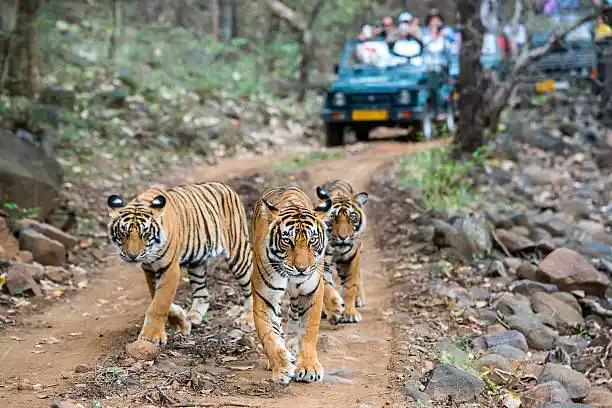
Tadoba Andhari National Park Ticket Price
The History of Tadoba: A Forest That Changed Its Purpose Three Times
Most write-ups treat Tadoba’s history as a list of years and acts. The more interesting way to look at it is that this forest has actually served three completely different purposes over the last 150 years — timber estate, hunting ground, and finally a tiger sanctuary — and each shift left a mark still visible today.
Phase one: a working forest, not a wild one. When the British administration declared the area a reserved forest in 1879, the goal had nothing to do with animals. Teak from this belt was valuable timber, and “protection” meant protecting a resource, not a species. If you’ve ever wondered why teak so heavily dominates Tadoba’s canopy today, this is part of the answer — over a century of managed extraction shaped which trees got room to dominate.
Phase two: hunting under license, not hunting unchecked. It’s a common misconception that Tadoba was an open shooting ground before conservation “began.” In reality, restrictions were already tightening well before the park existed in any recognizable form — tiger hunting needed a permit as early as 1905, and by 1931 hunting of any animal was curbed further. What actually happened in 1942 is more revealing: colonial administrators formally converted the area into a game reserve, with named shooting blocks around Moharli, Karwa, Kolsa, and Mul. Permit-based tiger hunting in these blocks continued for another three decades — some of these same place names are the safari zones you’ll book a jeep for today.
Phase three: the turn toward protection. The 45 sq km patch around Tadoba Lake became a dedicated sanctuary in 1935, but the shooting blocks stayed active alongside it for years — protection and hunting literally overlapped on the same map for a while. It wasn’t until 1955 that Tadoba was declared a national park in the modern sense, and even then, the last licensed hunting blocks weren’t shut for good until sometime in the 1970s. The Andhari Wildlife Sanctuary was added next door in 1986, and the 1993 merger of the two finally created the single reserve — Tadoba Andhari Tiger Reserve — that exists on the map now.
Why this matters for a visitor, not just a history buff: the zone names you’ll pick between when booking a safari — Moharli, Kolsa — are the direct descendants of licensed hunting blocks from the 1940s. The forest you’re driving through for a photograph today is the same ground where permit hunting was still legal within living memory. That continuity, more than any single date, is what makes Tadoba’s conservation story worth more than a passing paragraph.
Tadoba Andhari Tiger Reserve Timings
Safari timings shift with the season, since they’re built around daylight and animal activity patterns rather than a fixed clock. As a general guide:
October–February: Morning shifts start around 6:00–6:30 AM; afternoon shifts run roughly 2:00–6:00 PM.
March–April: Morning shifts begin slightly earlier to beat the rising heat; afternoon shifts start a little later.
May–June: Morning safaris start as early as 5:30 AM, and afternoon shifts push later, into the 7:00 PM range, to avoid the harshest midday heat.
July–September: Core zones remain closed for the monsoon; select buffer gates may stay open on specific days.
Always confirm exact shift timings on the official portal before you travel — the Forest Department adjusts these slightly year to year based on daylight hours and weather.
Conservation and the People of Tadoba
It’s tempting to write Tadoba up as a clean conservation success story. The fuller picture is more layered, and worth understanding before you visit.
Tens of thousands of people still live in villages in and around the reserve, including a handful inside the core zone, where farming continues alongside protection efforts. Rehabilitating these villages out of the core area is an ongoing, gradual process, not something fully resolved.
That proximity creates real friction. Livestock losses to tigers and leopards remain a recurring problem for nearby communities — a genuine tension between conservation priorities and the economic reality of living beside a tiger reserve. Forest fires are another recurring risk during the dry season.
The flip side: tourism revenue is one of the primary sources funding anti-poaching patrols and local employment — guides, drivers, resort staff, and small businesses all depend on the safari economy. Booking a safari here isn’t just an experience; it’s part of what keeps that conservation incentive intact.
Tadoba for Every Kind of Traveler
Families with kids: A canter safari is more forgiving if a child gets restless, and shorter morning slots work better than full-day safaris for younger children.
Photographers and birders: Prioritize Moharli or Kolsa for tiger photography, and set aside separate time near Tadoba Lake specifically for birding rather than folding it into a tiger-focused drive.
Couples and honeymooners: A luxury lodge paired with a private jeep, rather than a shared canter, is worth the extra cost for a quieter, more personal experience.
Students and educational groups: A registered operator makes coordinating permits for larger numbers far easier, and framing the trip around ecology and conservation tends to make for a richer visit than chasing sightings alone.
Solo and international travellers: The booking portal and on-ground process aren’t always intuitive if you’re unfamiliar with Indian wildlife tourism norms — this is one case where an operator’s fee buys genuine peace of mind.
Adventure seekers: Full-day safaris and the quieter Kolsa or buffer zones reward patience more than repeatedly chasing the most popular gate.
How to Reach Tadoba Andhari Tiger Reserve
By air: Nagpur’s Dr. Babasaheb Ambedkar International Airport is the nearest, roughly 140–150 km away, about a 2 to 3-hour drive depending on your gate.
By train: Chandrapur railway station is closer, at around 45 km out, with Nagpur junction as a well-connected alternative.
By road: Tadoba connects well to Nagpur, Pune, Hyderabad, and Mumbai, and self-driving or hiring a cab from Nagpur is a common, comfortable option.
Which route makes sense depends on your gate. A Kolsa-bound trip and a Moharli-bound trip don’t share the same best approach road, so confirm the route with your stay or operator before finalizing transport.
Frequently Asked Questions
Is Tadoba Andhari Tiger Reserve better than Ranthambore or Jim Corbett? The outcome is contingent upon the specific objectives you are aiming to optimize for. Tadoba’s dry deciduous terrain and tiger density give it sighting odds that are comparable to or better than Ranthambore in many seasons. Corbett has denser forest and a different sighting rhythm altogether. No single reserve wins across every category.
How many tigers are in Tadoba Andhari Tiger Reserve? Estimates range from roughly 90 to 115, depending on the survey year. Always check the most recent official census figure before you travel, since these numbers shift.
Is a Tadoba safari worth it in summer? Yes, if you can handle the heat — sighting odds often improve as animals concentrate near water sources during the hottest months.
Can I do online safari booking for Tadoba Andhari Tiger Reserve without an agent? Yes. You can book core-zone permits directly through the official Forest Department portal. A guide is typically mandatory once inside the park regardless of how you booked.
What is the Tadoba Andhari National Park ticket price for a jeep safari? It varies by zone, season, and vehicle type, and includes the entry fee, guide fee, and applicable taxes on top of the vehicle hire — check current rates on the official portal before booking, since fees are revised periodically.
How many days are enough for Tadoba? Two to three days with at least two to three separate safaris gives you a realistic shot at a strong sighting while covering more than one zone.
Is Tadoba safe for solo female travellers? The park and safari process are well-regulated. As with solo travel anywhere in India, standard precautions around accommodation and local transport still apply.
Tadoba Andhari Tiger Reserve rewards travellers who plan a little smarter than the crowd — picking the right zone for their priorities, booking early instead of gambling on Tatkal, and budgeting honestly for the real cost of a safari rather than the headline number. Whether you’re chasing your first tiger sighting, building a birding list, or planning a once-in-a-lifetime honeymoon safari, the difference between an average trip and a genuinely great one usually comes down to preparation, not luck.
Call to Action
Ready to lock in your dates? Book your safari directly through the official Tadoba Andhari National Park online booking portal, or explore curated Tadoba Andhari Tiger Reserve packages if you’d rather have your zones, stay, and permits handled for you. Either way, book early — the best gates fill up fast.