Dudhwa National Park
- Home
- Dudhwa National Park
Dudhwa National Park
Dudhwa National Park: The Complete 2026 Visitor's Guide
Ask five people who’ve actually been to Dudhwa National Park what it’s like, and you’ll get five different answers. “Quiet.” “Underrated.” “Harder to spot tigers than Corbett.” “Best birding trip of my life.” Here’s the thing — they’re all right.
Dudhwa doesn’t perform for visitors the way some of India’s more famous parks do. There’s no guarantee of a tiger strolling past your jeep in the first hour. What you get instead is patience rewarded: tigers and rhinos sharing the same landscape, grasslands that stretch further than your eye can really process, and a kind of silence most wildlife parks lost to jeep traffic years ago.
This guide skips the recycled Wikipedia facts you’ve probably already read elsewhere. Instead, it’s built to actually get you there — safari zones, real booking steps, fee structures, timings, and honest comparisons — so you land at the gate knowing exactly what to expect.
Best Time to Visit Dudhwa National Park
Best Time to Visit Dudhwa National Park
The park runs on a fixed calendar: open 15 November to 15 June, closed the rest of the year for monsoon and breeding season. No exceptions, so build your entire trip around that window first.
Within it, timing depends on what you’re chasing:
November–February (winter): The most comfortable stretch — 20–30°C, ideal for birdwatching as migratory species arrive in force. It’s also the most crowded period, so book early. Pack warm layers; early mornings get properly cold, especially December through February.
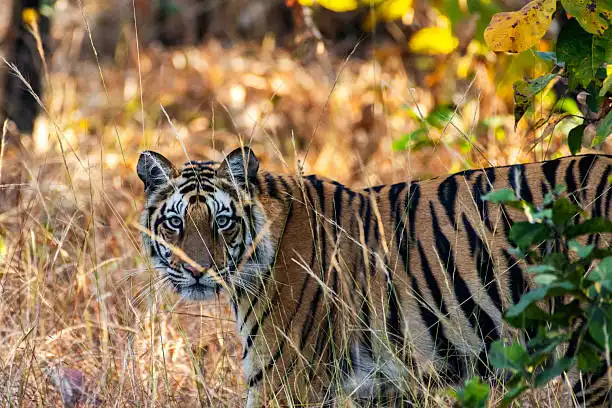
March–mid-June (summer): Hot, climbing toward 40°C by May. Counterintuitively, this is often the better window for tiger sightings — shrinking water sources and thinning grass cover push animals into the open.
July–mid-November: Park closed entirely. Don’t plan a trip anywhere near this window.
Quick rule of thumb: chasing tigers, lean toward late April or May despite the heat. Chasing birds and comfort, go with December or January.
What Is Dudhwa National Park?
Dudhwa National Park sits in the Lakhimpur Kheri district of Uttar Pradesh, right up against the Indo-Nepal border. The core park spans roughly 490 sq km, but it’s really the anchor of a much larger protected complex — the Dudhwa Tiger Reserve — which covers close to 1,284 sq km once you include Kishanpur Wildlife Sanctuary and Katarniaghat Wildlife Sanctuary nearby.
What sets it apart from most parks on an Indian wildlife circuit is the terrain itself. This is Terai country: tall elephant grass, dense sal forest, and marshland fed by the Mohana and Suheli rivers, sitting on an alluvial plain just below the Himalayan foothills. It’s the last real stronghold of the swamp deer (barasingha), one of the only places in Uttar Pradesh where the Indian one-horned rhinoceros survives, and home to species like the hispid hare and Bengal florican that have vanished from almost everywhere else in the country.
| Detail | Information |
|---|---|
| Core area | ~490 sq km (buffer zone: ~190 sq km) |
| Tiger Reserve area | ~1,284 sq km (includes Kishanpur & Katarniaghat) |
| District | Lakhimpur Kheri, Uttar Pradesh |
| Notified as sanctuary | 1958 (for swamp deer) |
| Declared national park | 1977 |
| Declared tiger reserve | 1988 |
| Open season | 15 November – 15 June |
| Nearest airport | Lucknow (~230 km) |
| Nearest railhead | Palia / Dudhwa branch line; Sitapur Junction (~134 km) |
Dudhwa National Park Safari Charges, Ticket Price & Booking
This is the section most visitors actually search for, so let’s get specific.
Dudhwa National Park safari charges are structured in tiers: separate rates apply for Indian nationals versus foreign nationals, plus additional charges for the vehicle and for cameras or video equipment. Foreign tourist rates run noticeably higher than domestic ones. Because the UP Forest Department revises the Dudhwa National Park ticket price periodically, treat any number you find online — including on tour operator websites — as indicative only. Confirm current rates directly on the official UP Ecotourism booking portal or by phone before you travel.
How to Book Dudhwa National Park
Go to the official source. Complete your Dudhwa National Park safari booking through the official UP Ecotourism portal or a verified, authorized operator — skip unofficial resellers entirely.
Check Dudhwa National Park safari timings. Safari slots run in two daily windows, roughly 6:00–9:30 AM and 3:00–6:00 PM, shifting slightly by season.
Book ahead. A week’s notice is usually enough for weekday visits. For weekends and the December–January peak season, book 2–3 weeks out if you want a specific zone.
Carry proof. Bring a printed or digital booking confirmation plus photo ID — gate checks are routine and strictly enforced.
For Dudhwa National Park online booking specifically, one honest heads-up: smaller reserve portals like this one are less battle-tested than Corbett’s or Ranthambore’s. Slots can appear available and then fail at payment, or the portal can slow down during peak booking windows. Keep a backup — a local travel agent’s number or your resort’s booking desk — rather than relying solely on the website the night before your trip.
How to Book Dudhwa National Park
History of Dudhwa National Park
The history of Dudhwa National Park doesn’t start with a park at all — it starts with a hunting ground. During British rule, this stretch of Terai forest was used for shikar, and by the early 20th century, unchecked hunting and encroachment had pushed the swamp deer population to the edge.
In 1958, the Uttar Pradesh government stepped in and notified the area as a wildlife sanctuary, specifically to protect the barasingha. That protection held for almost two decades before the next big shift: in 1977, the sanctuary was upgraded to a full national park, and additional forest land was folded in.
Then came 1988, when Dudhwa National Park, Kishanpur Wildlife Sanctuary, and Katarniaghat Wildlife Sanctuary were combined and declared the Dudhwa Tiger Reserve under Project Tiger — recognition of just how significant the area’s Bengal tiger population had become.
That’s the short version. The longer, more interesting version involves one man who refused to let the forest disappear — which is where the biography of Dudhwa National Park really begins.
Biography of Dudhwa National Park: The Billy Arjan Singh Story
If Dudhwa has a founding figure, it’s Billy Arjan Singh. Born in 1917, Singh was a naturalist and conservationist who spent decades of his life fighting to protect this specific patch of Terai forest — at a time when almost nobody in India was thinking seriously about tiger conservation.
Singh didn’t just lobby for protection from a distance. He lived it. He’s credited with pioneering the rehabilitation of captive-born tigers and leopards back into the wild — hand-rearing animals and releasing them into Dudhwa’s forests, which was genuinely radical conservation work for the era. He also played a direct role in convincing the government to declare the area a national park in 1977, and his influence extended beyond Dudhwa — he was instrumental in establishing Sariska Tiger Reserve in Rajasthan as well.
He wrote several books documenting his work, including Tiger Haven, and received recognition including the Padma Shri and the Order of the Golden Ark before his death in 2010 at the age of 92. Walk through Dudhwa today, and you’re walking through the direct result of one person’s stubbornness.
Birding in Dudhwa National Park
Birding in Dudhwa National Park & Photography Tips
Dudhwa is harder to shoot than open parks like Ranthambore, and it helps to know that before you pack. Tall grass and dense sal cover mean fewer clean sightlines, so a mid-range zoom (roughly 150–500mm equivalent) gives you more flexibility than an ultra-long prime that struggles in tight gaps between grass and tree cover.
Best light: Early morning safaris, the first hour after gate opening, give the softest light and highest activity — especially in open zones like Salukapur.
Water bodies: Bankati’s water sources are reliable spots during April–May, when animals concentrate around whatever water remains. Patience at a waterhole often beats covering more ground.
For birders specifically: Winter (December–February) is peak migratory season. Bring a spotting scope if you’re serious — many waterbirds sit further out than a camera lens comfortably reaches.
Noise discipline: Vehicle noise carries further in open grassland than in dense forest, and animals react to it from a greater distance. A quiet, patient approach consistently outperforms constant repositioning.
Flora and Fauna of Dudhwa National Park
This is where Dudhwa genuinely earns its reputation. The flora and fauna of Dudhwa National Park read like a greatest-hits list of Terai wildlife, and a few numbers here are worth knowing because they tell you what’s actually working.
Swamp deer (barasingha): The species the park was originally created to protect. Numbers have grown from around 3,691 in 1977 to over 6,100 by 2022 — one of India’s genuine conservation success stories.
Indian rhinoceros: Reintroduced in 1984–85 using animals brought from Assam and Nepal, after rhinos had been locally extinct here for roughly 150 years. As of 2024, around 46 rhinos call Dudhwa home, with forest authorities continuing to release more from breeding enclosures.
Leopards: Population has jumped from 34 in 2022 to 93 by 2025 — unusually fast growth that signals a genuinely recovering habitat.
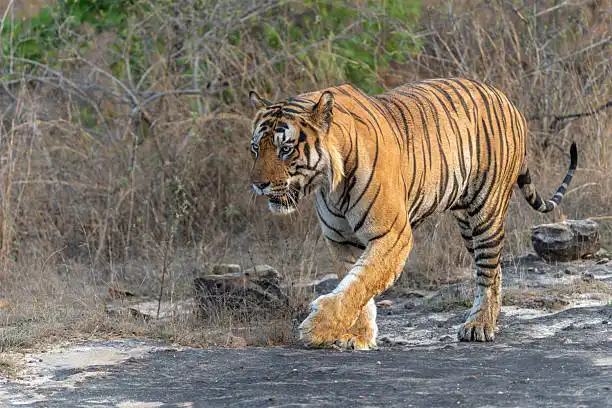
Tigers: Present, but more elusive here than in tiger-dense parks like Bandhavgarh. The dense grass simply gives them more places to vanish.
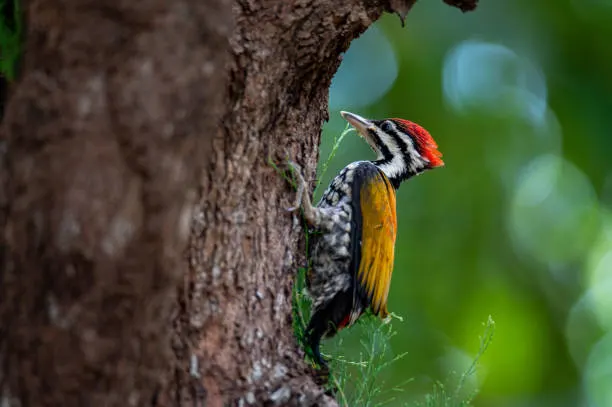
Birdlife: Over 450 species recorded, including the critically endangered Bengal florican, sarus cranes, hornbills, painted storks, and occasional sightings of the white-rumped and red-headed vulture.
Vegetation: Sal forest dominates the drier stretches, giving way to marshland and the tall elephant grass that defines much of the park’s open terrain — this grass-forest mix is exactly why the biodiversity here is so dense.
One more detail worth knowing: the hispid hare, once believed extinct, was rediscovered in Dudhwa in 1984. Every sighting in this park tends to come with a backstory like that.
Safari Zones — Where to Actually Go
Most guides gloss over this, but it’s the part that changes your trip the most. Dudhwa isn’t one uniform block of forest — each zone has different terrain, and that terrain decides what you’ll likely see.
Sonaripur: Dense sal forest mixed with grassland — a solid, well-rounded zone tied to the park’s early conservation history.
Salukapur: Open grassland stretches, strong for swamp deer herds and open-country birding.
Kakraha: Closer to the Katarniaghat side, more forested and quieter in terms of vehicle traffic.
Bankati: Built around water bodies — a strong pick for waterbirds and animals coming to drink, especially in the hotter months.
Sathiana: Mixed habitat, generally reliable for elephant and deer sightings.
If photography is your priority, Bankati (for water-body compositions) or Salukapur (for open-grassland shots with a long lens) are your best bets. Traveling with family or visiting for the first time? Sonaripur or Sathiana tend to be more forgiving and consistent.
Jeep Safari Booking in Dudhwa National Park
For jeep safari booking in Dudhwa National Park, the open 4×4 gypsy is the standard choice — small groups, flexible routing, and easy to reposition quickly if a photographer spots something. Canters (shared, larger vehicles) are more budget-friendly but noisier and less flexible, which matters more here than in denser parks since sound travels far across open grassland. Elephant safaris occasionally run and can access tall-grass areas jeeps simply can’t reach, though availability depends on season and forest department policy — always confirm locally rather than assuming it’s on offer.
How to Reach Dudhwa National Park
By air: The nearest airport is Chaudhary Charan Singh International Airport in Lucknow, about 230 km away — roughly a 4.5 to 5-hour drive. There’s no closer commercial airport, so build that transfer time into your plan rather than treating “fly to Lucknow” as the finish line.
By rail: Dudhwa has its own small station on a North Eastern Railway branch line, though connectivity is limited. Sitapur Junction (~134 km) and Lakhimpur Junction (~85 km) offer better connections to major cities, followed by a road transfer.
By road:
From Lucknow (~230 km): Lucknow → Sitapur → Lakhimpur → Gola → Khutar → Mailani → Palia → Dudhwa. About 5–6 hours depending on road conditions.
From Delhi (~430 km): Delhi → Moradabad → Bareilly → Pilibhit → Khutar → Mailani → Palia → Dudhwa. Around 8–9 hours — most Delhi travellers either break the journey overnight or fly into Lucknow first.
The final stretch from Palia to Dudhwa is narrower and slower than the highway sections before it. Don’t assume highway speed the whole way when timing your arrival against a safari slot.
The Tharu Community & Local Culture
The villages surrounding Dudhwa are home to the Tharu community, one of the Terai region’s indigenous peoples, whose connection to this landscape predates the park itself. Many Tharu villages sit within the buffer zone, and their traditional ecological knowledge has historically informed conservation efforts here.
If this interests you, arrange visits through local guides or your lodge rather than informal drop-ins — it keeps the interaction respectful and genuinely useful to the community instead of turning it into a photo stop. Handicrafts, traditional Tharu architecture, and local cuisine are worth carving out an extra half-day for, particularly if you’re traveling with an interest in history and culture alongside the wildlife.
| Dudhwa vs. Other Indian Wildlife Parks | ||||
|---|---|---|---|---|
| Here's the honest comparison, because you're likely weighing this against Corbett or Bandhavgarh before booking anything. | ||||
| Feature | Dudhwa | Jim Corbett | Bandhavgarh | Kaziranga |
| Tiger sighting odds | Moderate — needs patience | High | Very high | Low (not tiger-focused) |
| Crowd levels | Low | Heavy, especially weekends | Heavy in core zones | Moderate |
| Standout draw | Tiger + rhino + 450 bird species in one landscape | Reliable tiger sightings, mature infrastructure | Highest tiger density in India | Rhino population, but minimal tigers |
| Typical cost | Lower | Moderate to high | Moderate to high | Moderate |
| Accessibility | Harder — no direct flights, longer drive | Easy from Delhi | Easy from major cities | Requires a flight to Assam |
If you want a guaranteed tiger photo, Corbett or Bandhavgarh will get you there faster. If you want a park that still feels genuinely wild — where you might complete an entire safari without seeing another vehicle — Dudhwa is arguably the better trip. It’s also the only park in North India where you can realistically see both tigers and rhinos without adding a flight to Assam.
Resorts and Where to Stay Near Dudhwa National Park
Resorts near Dudhwa National Park generally fall into three tiers:
Forest Rest Houses (FRHs): Run by the UP Forest Department, located inside or near the park. Basic but genuinely atmospheric — you wake up to the forest itself. Best for budget travellers, but book well ahead since rooms are limited and heavily contested in peak season.
Private resorts in Palia Kalan: The main gateway town has a growing cluster of mid-range resorts with proper dining and often safari-booking assistance built in. A solid middle ground for families.
Higher-end lodges: A smaller number of properties cater to the luxury and honeymoon segment, with curated dining and guided experiences bundled in. There are fewer options here than Corbett’s luxury belt, so book early if this is your category.
Whichever tier you choose, confirm proximity to your intended safari gate first. Dudhwa’s gates are spread out, and a resort near one gate can mean a long, avoidable drive if your safari slot ends up booked at another.
Dudhwa National Park Tour Packages
2-Day Quick Trip (from Lucknow) Day 1: Drive in, arrive by afternoon, evening safari in Sonaripur or Salukapur. Day 2: Morning safari in a different zone — Bankati for photography, Sathiana for general wildlife — then head back to Lucknow. Best for time-constrained travelers who want a genuine taste without a long commitment.
3-Day Full Experience Day 1: Arrive, settle in, evening safari. Day 2: Morning safari in Dudhwa’s core, afternoon drive to Kishanpur Wildlife Sanctuary for a change of terrain. Day 3: Final morning safari, then depart. This is the sweet spot for most wildlife lovers and photographers.
4–5 Day Terai Circuit Adds Katarniaghat Wildlife Sanctuary, known for gharial and river-based wildlife along the Girwa river, plus extra birding time. Best suited to serious photography groups, students on an ecosystem-focused trip, or anyone treating this as a dedicated wildlife holiday rather than a weekend add-on.
If you’d rather skip the planning, most Dudhwa National Park tour packages offered by local operators map onto these same routes — the real difference between packages usually comes down to inclusions like meals and guide fees, not the itinerary itself.
Families with young kids should lean toward the 2 or 3-day version; five straight days of 5:30 AM safari starts is a lot to ask on a casual trip. Honeymooners tend to do better with the 3-day version paired with a higher-end lodge, which leaves breathing room between safaris instead of a packed schedule.
Conservation Story: From Near-Extinction to Recovery
The numbers tell this story better than adjectives can. Barasingha population has nearly doubled since the 1970s. Rhinos, locally extinct for roughly 150 years, now number around 46 following a deliberate multi-decade reintroduction effort. Leopard numbers have nearly tripled in just three years.
This isn’t a park that was always thriving — it’s one that was actively rebuilt, species by species, and it’s still very much a work in progress. That’s part of what makes a visit here feel different from parks where the “conservation story” is mostly historical rather than ongoing.
Rules, Safety & Responsible Visiting Tips
Enter only with a confirmed safari booking and the required permits — spot bookings at the gate are unreliable.
Stay inside your vehicle at all times; the grassland already limits visibility without adding foot traffic to the mix.
Keep noise down — no music, loud conversation, or phone calls during safaris. Sound carries further here than in dense forest.
No smoking inside the park. Dry grass in summer is a serious fire hazard.
Don’t make the trip tiger-obsessive. Given the terrain, you’re statistically more likely to have a great birding or deer-sighting safari than a tiger safari — treat that as the park’s actual strength.
Solo and foreign travellers: guides are generally mandatory inside the park, which works in your favour for both safety and spotting wildlife you might otherwise miss.
FAQs
Is Dudhwa National Park better than Jim Corbett? It depends on what you’re after. Corbett offers higher tiger-sighting odds and easier access from Delhi. Dudhwa offers fewer crowds, stronger birding, and the rare combination of tigers and rhinos in one park.
What is the Dudhwa National Park ticket price? Rates vary by visitor category (Indian vs. foreign nationals), safari type, and vehicle or camera charges, and they’re revised periodically. Always confirm current pricing on the official UP Ecotourism portal before traveling.
How do I complete Dudhwa National Park online booking? Book directly through the official UP Ecotourism portal or a verified, authorized operator. Avoid third-party resellers, and keep a backup contact in case the portal is slow during peak season.
What are the Dudhwa National Park safari timings? Safaris run in two windows daily — roughly 6:00–9:30 AM and 3:00–6:00 PM — with slight seasonal adjustments.
How many days are enough for Dudhwa? Three days is the sweet spot — enough to cover 2–3 safari zones and add Kishanpur Wildlife Sanctuary without rushing. Two days works if you’re short on time.
Can foreign tourists visit without a guide? No. Guides are required inside the park for all visitors, which is standard practice at Indian tiger reserves.
What’s the realistic tiger sighting probability? Lower than Bandhavgarh or Ranthambore due to dense grass cover, but not negligible — it improves in the hotter months (April–May) as water sources shrink and grass thins out.
Is Dudhwa safe for solo or family travellers? Yes. It’s a well-regulated forest reserve with mandatory guides and fixed safari routes. The bigger practical challenge is logistics — limited flight and train connectivity — rather than safety on-site.
Dudhwa National Park isn’t the easiest wildlife destination in India to reach, and it won’t hand you a guaranteed tiger photo the way Bandhavgarh might. What it offers instead is rarer: a genuinely wild Terai landscape where tigers, rhinos, leopards, and over 450 bird species share the same grasslands, largely undisturbed by the crowds that have reshaped India’s more famous parks. If you plan around the right season, book your safari zone deliberately, and go in with realistic expectations, Dudhwa delivers an experience that’s hard to replicate anywhere else in North India.
Ready to plan your trip? Check current Dudhwa National Park safari charges, confirm safari timings for your travel dates, and lock in your safari booking through the official UP Ecotourism portal well before peak season fills up — the best zones and Forest Rest Houses go first.